

Imaging First Light!
For over a year now, we’ve been trying to set up an imaging system out at the observatory. Imaging on a telescope is a bit more complicated than simply swapping out the eyepiece for a camera. Namely, leaving the back end of the telescope, these are the following components:
Mount adapter > Spacer > PLL Esatto Focuser > Pegasus Falcon 2 Rotator > Spacer > ZWO Filter Wheel > ZWO ASI2600MM Camera
At first we weren’t able to attach the imaging train to the telescope because the part that was machined for this purpose was slightly outside of the specifications we provided. Next, we had backfocus issues (our camera wasn’t the right distance from the back end of the telescope). Then we realized we had a rotator that was incompatible with the system. Finally, earlier this month, we got everything (mostly) sorted out and captured our first image!!! The target we chose to image was the Pinwheel Galaxy.
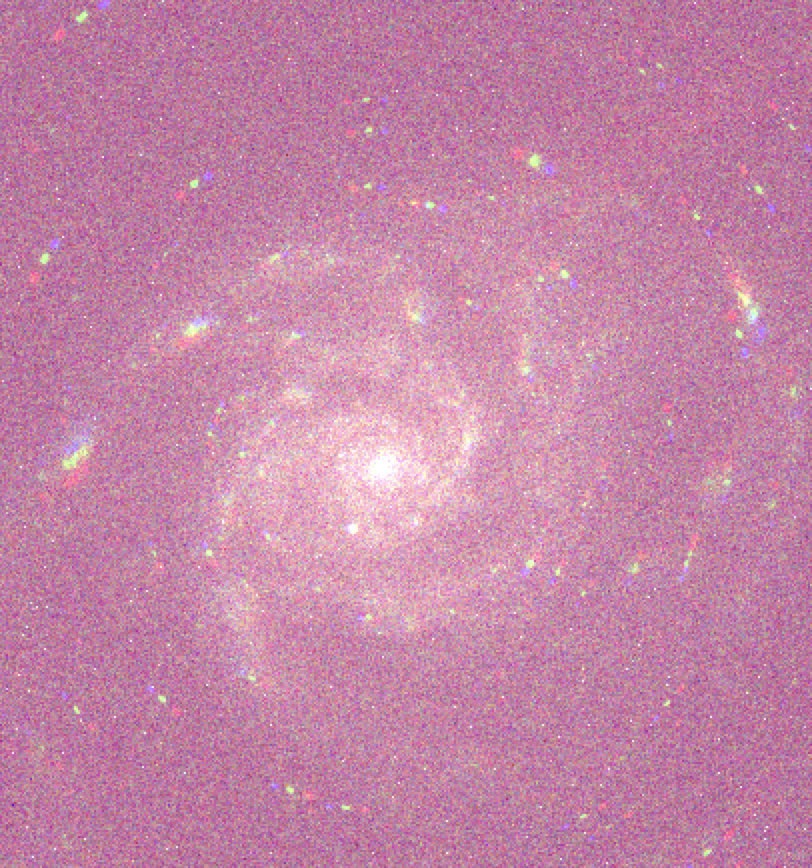
The Pinwheel Galaxy (M101) captured at the Asterisk Observatory.
The Pinwheel Galaxy, also known as Messier 101 or M101, is one of the most stunning spiral galaxies visible from Earth. Located approximately 21 million light-years away in the constellation Ursa Major, this massive galaxy spans nearly 170,000 light-years across — making it almost twice the size of our own Milky Way Galaxy.
Discovered in 1781 by French astronomer Pierre Méchain, M101 is famous for its elegant “pinwheel” structure. Its sweeping spiral arms are packed with bright clusters of young stars, glowing nebulae, and active regions of star formation. These vivid details make the galaxy a great target for observations.
One of the most fascinating aspects of the Pinwheel Galaxy is its asymmetrical appearance. Unlike many other spiral galaxies which present with more balanced spiral structure, M101’s arms appear uneven and distorted. Scientists believe this unusual shape is the result of gravitational interactions with nearby companion galaxies over millions of years. These cosmic encounters likely triggered waves of star birth throughout the galaxy’s spiral arms.
Fun fact: In 2023, a supernova was discovered in the M101 galaxy by Japanese amateur astronomer Koichi Itagaki. The supernova, known as SN 2023ixf, provided researchers with valuable insights into stellar evolution and cosmic explosions.
For stargazers, the Pinwheel Galaxy remains a remarkable reminder of the immense beauty and scale of the universe. Even from millions of light-years away, M101 continues to inspire curiosity about the galaxies beyond our own.
You may notice that I said above, parenthetically, that we mostly have the imaging system figured out. If you look closely, you will see that the stars, especially at the outer edges of the image, are spread out and each star appears three times as a red, green, and blue dot. We still have some minor tweaking to work out with the field rotator.
Even though summer nights are short, I look forward to the upcoming warm summer nights and capturing more images with the telescope’s new capabilities!