Guest Post - Astronomy News
James Di Francesco is an astrophysicist at the Herzberg Astronomy and Astrophysics Research Centre in Victoria, BC, Canada. He was my research advisor for the three years that I was a postdoctoral researcher. He writes a daily newsletter about an object or topic in astronomy. I will be re-posting some of his newsletter content here.
——
Pa 30 is located in the northern constellation of Cassiopeia, that “W” you can see in the sky on the other side of the North Star from the Big Dipper (Ursa Major). It is estimated to be about 8,000 lightyears from the Sun. Pa 30 was actually discovered only by an “amateur” astronomer named Dana Patchick in 2013 but it is likely the leftovers of a supernova that was seen around the world in the night sky in 1181 AD. In many ways, it is a unique object in our Galaxy. The central object appears to be a very hot and surprisingly massive white dwarf that has somehow avoided collapse into a neutron star – perhaps the supernova was a bit underpowered, relatively speaking, arising from the merger of two lower-mass white dwarfs. The resulting white dwarf that coalesced out of the two smaller ones can’t stay in its current state – it is too massive and will likely collapse under its own weight within 10,000 years, producing a second large explosion.
The white dwarf is also associated with extremely fast winds that are blowing at a shocking 16,000 km/s. Indeed, it is that fast wind that may give Pa 30 its unusual firework like appearance. Prior to the supernova, the dying star probably began shedding its outer layers and these moved outwards at a relatively slow speed. The underpowered supernova obviously didn’t sweep those layers away. The fast wind now blowing from the central object has caught up to that previously ejected material, and the interaction between the two flows has produced the knotty radial filaments we see today. Note that these knots are still quite big, each would be about 10 times the Sun-Neptune distance wide. The knots are surprisingly uniform and will provide insight into how the flows interacted. For more information, here’s a link to the story on phys.org and a link to the team’s paper, published earlier this week in The Astrophysical Journal.
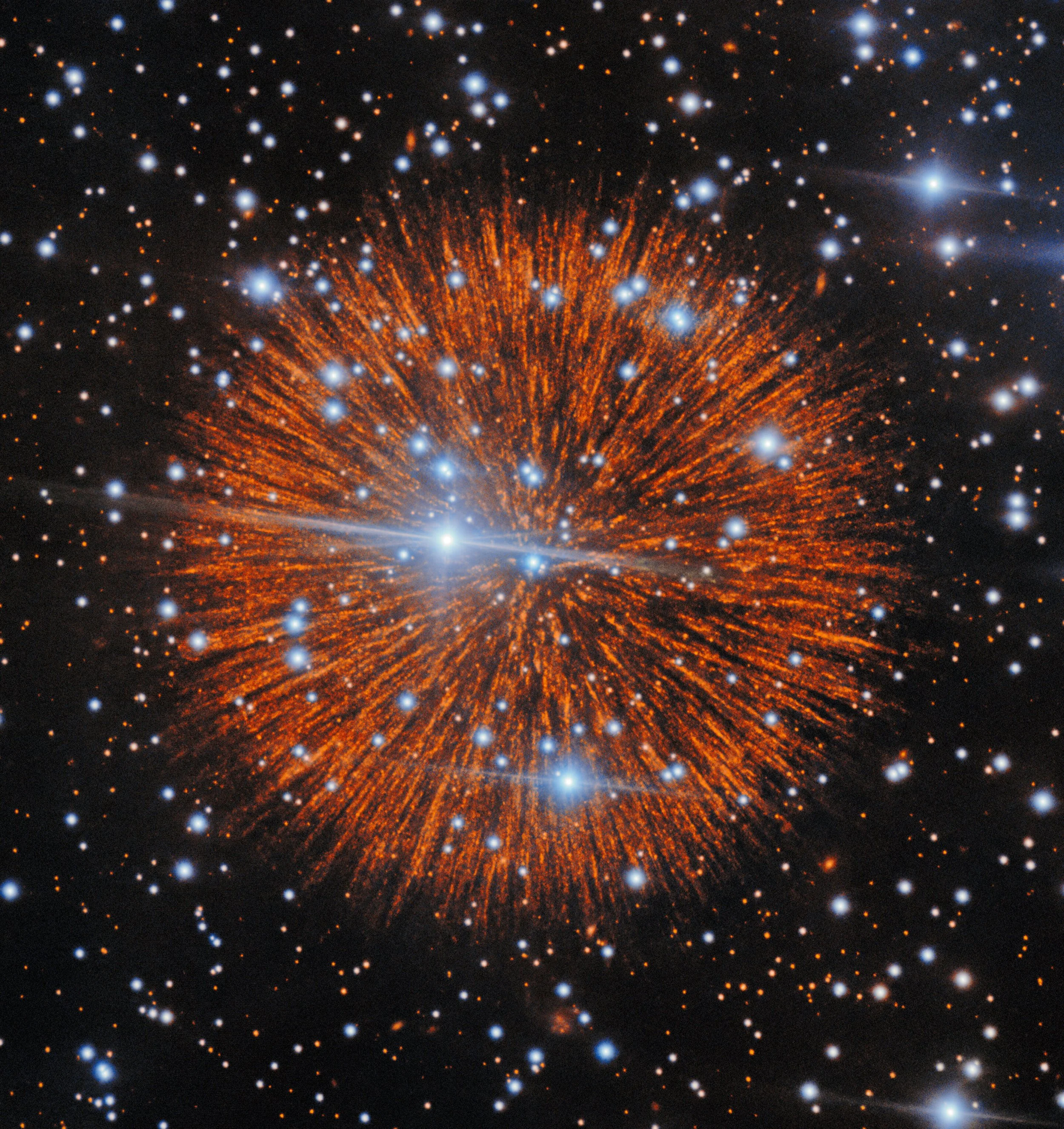
Pa 30 is a supernova remnant in the constellation Cassiopeia. Credit: International Gemini Observatory/NOIRLab/NSF/AURA. Acknowledgment: PI: T. Cunningham (Center for Astrophysics - Harvard & Smithsonian). Image Processing: J. Miller & M. Rodriguez (International Gemini Observatory/NSF NOIRLab), T.A. Rector (University of Alaska Anchorage/NSF NOIRLab), D. de Martin & M. Zamani (NSF NOIRLab).